

1 Stage vs 2 Stage Furnace: Making the Right Upgrade Decision After a Fall Breakdown
See why we recommend early fall checkups using these home maintenance tips and troubleshooting. Decide if your furnace needs a quick fix or an upgrade.

Are those strange burning dust smells and rattling noises just your heating system waking up for the season, or a warning sign that it is on its last legs? When our technicians at Amazing Air Inc respond to early November service calls across North Aurora IL, this is one of the most common questions we receive. As you search for home maintenance tips and troubleshooting to figure out why your house still feels chilly, getting an accurate diagnosis is your top priority. The initial cold snaps of late fall put sudden, heavy stress on dormant equipment. For many homeowners we work with, turning on the thermostat in November reveals underlying mechanical issues that cannot be ignored.
It is entirely normal to experience a brief burning smell during your initial startup as settled dust burns off the heat exchanger. However, if you notice continuous short-cycling, inconsistent temperatures from room to room, or loud grinding noises, you are likely dealing with a failing system rather than a standard seasonal hiccup. Addressing these symptoms during your November pre-winter readiness checks gives you the time and flexibility to make a smart, unhurried decision.
If our professional troubleshooting reveals that your current unit is unsafe or beyond repair, you face an important choice. You must decide which type of heating technology will take its place to ensure your family's long-term comfort. Upgrading your equipment is a major investment in your property, and in our experience, selecting the right technology dictates your comfort for the next fifteen to twenty years. To explore your options, you can review professional heating services to see how modern systems operate.
The primary decision you will need to make is whether to install a traditional single-stage unit or upgrade to a more advanced two-stage model. Understanding how these different systems deliver heat, use energy, and adapt to the local climate will help you secure a reliable, warm winter.
Before you can make an informed decision about your next heating system, you need to understand what HVAC professionals mean when they talk about "stages." In simple terms, a stage refers to the operational speed of the furnace's gas valve and burner assembly. This mechanical function dictates exactly how heat is generated and distributed throughout your living space.
Many older homes in North Aurora IL that our team inspects still rely on outdated technology that only operates at a single speed. Modern engineering, however, allows newer systems to adjust their output based on the exact temperature demand of the house. Understanding this basic mechanical difference is crucial before investing in furnace replacement and installation.
A single-stage furnace is the most basic type of central heating system available. Its operation is straightforward, but it lacks nuance.
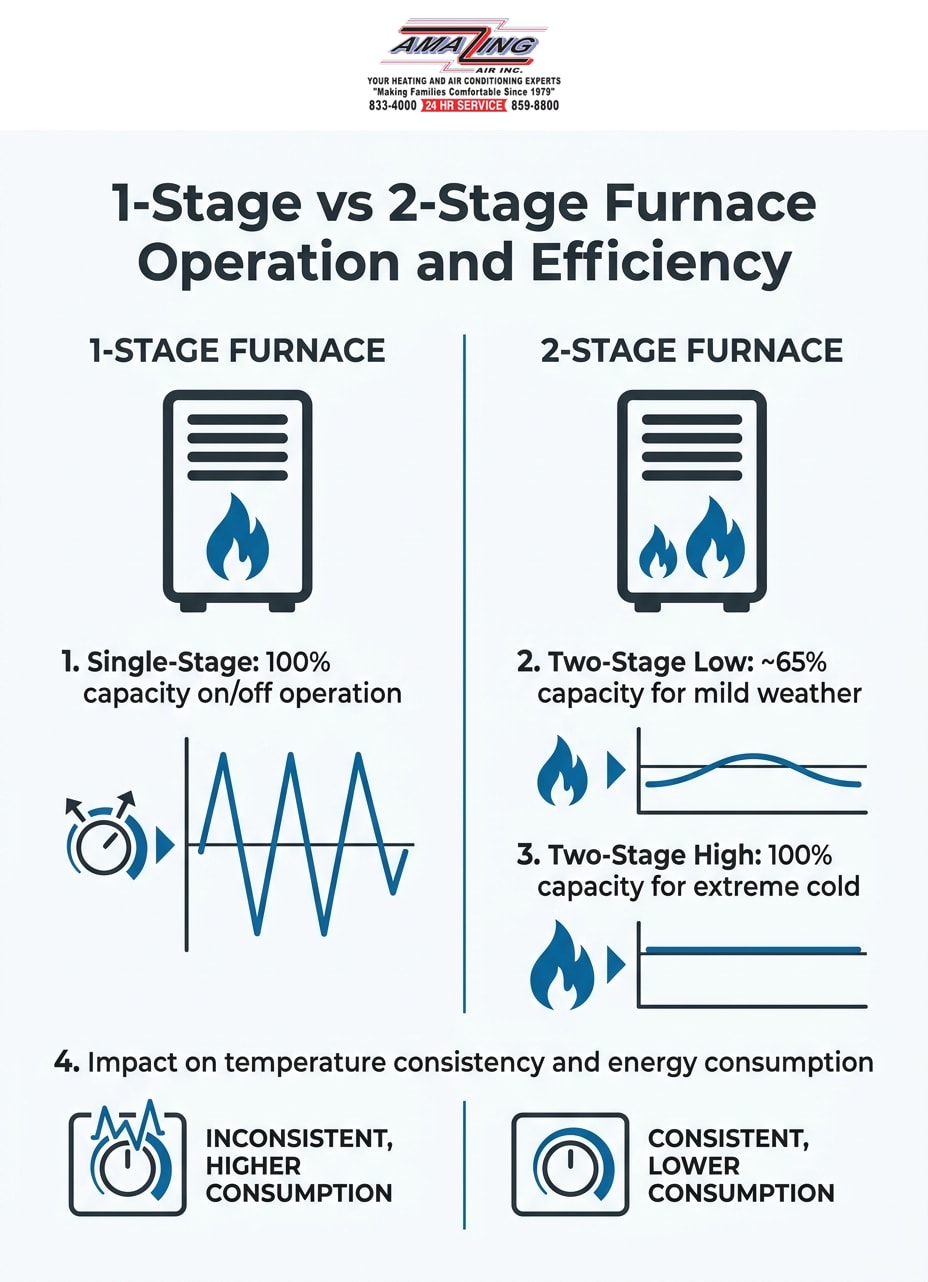
1. Full capacity operation: Whenever your thermostat detects that the room temperature has dropped below your set point, it sends a signal to the control board. The gas valve opens completely, and the burners fire at 100% capacity.
2. Maximum airflow: The blower motor pushes air over the extremely hot heat exchanger at full speed, delivering maximum heat into your ductwork.
3. Abrupt shutdown: Once the thermostat registers that the target temperature has been reached, the gas valve shuts off completely. The system goes from 100% output directly to zero.
There is no middle ground with a single-stage system. It is either blasting hot air at maximum capacity or doing nothing at all.
A two-stage furnace features a more sophisticated gas valve and control board that allows it to operate at two distinct speeds, adapting to the weather outside.
1. The low stage: During mild weather, the furnace operates in its first stage, which typically utilizes only about 65% of its total heating capacity. The gas valve partially opens, and the blower runs at a lower, quieter speed.
2. Continuous comfort: This low stage allows the system to run for longer, gentler cycles, easily maintaining the target temperature without blasting the rooms with excessive heat.
3. The high stage: When the outdoor temperature plummets and the low stage can no longer keep up with the heat loss of your home, the system automatically shifts into the second stage. The valve opens fully, utilizing 100% capacity to combat extreme cold.
Single-stage furnaces have been the industry standard for decades. In our years of replacing heating systems, we've found their primary advantage is their simplicity. Because they have fewer advanced electronic components and a basic on/off gas valve, they historically carry a lower upfront cost. For homeowners on a strict budget, a single-stage unit provides reliable, basic heating.
However, we frequently see this traditional technology present significant drawbacks, particularly during the transitional weather of autumn. Because a single-stage furnace only knows how to run at 100% capacity, it often overheats the house very quickly on a mild 45-degree day. The thermostat registers the rapid temperature rise and immediately shuts the system down. Ten minutes later, the house cools off, and the cycle repeats.
The short-cycling problem: This rapid on-and-off behavior is known as short-cycling. Many homeowners we speak to mistake this inherent operational flaw for a mechanical breakdown during their November pre-winter readiness checks. While short-cycling can certainly indicate a failing part, it is also simply how an oversized single-stage unit behaves in mild weather. If you suspect your system is malfunctioning, scheduling an HVAC diagnostic visit is the safest way to find out if the unit is failing or just operating inefficiently.
Beyond the wear and tear caused by constant starting and stopping, single-stage systems often create noticeable comfort issues. Because the heat is delivered in short, intense bursts, you will likely experience temperature swings. The house feels too hot while the unit is running, and too chilly just before it kicks back on. Additionally, rooms furthest from the thermostat often become cold spots because the short cycles do not give the blower enough time to circulate warm air evenly throughout the entire ductwork system.
To understand the true value of multi-stage technology, you have to look at the environment it operates in. As local HVAC professionals, we know firsthand that the weather in northern Illinois is rarely consistent. We experience a wide spectrum of winter conditions, and your heating system needs to be able to handle all of them efficiently.
The problem with extreme temperature swings: The transition from mild 40-degree November days to the harsh sub-zero January nights typical of the North Aurora IL area requires a highly adaptable system. A single-stage furnace that is powerful enough to keep you warm during a polar vortex will be massively overpowered for a breezy autumn afternoon.
The cause of seasonal inefficiency: When an overpowered system runs on a mild day, it short-cycles. This wastes energy, creates uneven temperatures, and fails to adequately filter the air because the blower is not running long enough to pull airborne particles through your furnace filter.
The two-stage solution: We consistently recommend 2-stage furnaces because they perfectly handle this fluctuating climate. On those mild November days, the furnace relies almost entirely on its 65% low stage. It provides a continuous, gentle stream of warm air that prevents short-cycling. Because the system runs for longer periods at this lower capacity, it continuously circulates air through your filtration system, significantly improving your indoor air quality.
When the brutal sub-zero temperatures arrive in late January, the furnace recognizes the increased demand and seamlessly shifts into its 100% high stage. You get the raw heating power you need for extreme weather, without sacrificing efficiency and comfort during the milder months. Furthermore, because the system spends the vast majority of its life operating on the lower stage, you will notice a drastic reduction in operational noise. You no longer have to turn up the television every time the heat kicks on.
When we sit down with customers to weigh their upgrade options, it helps to see exactly how these two technologies stack up against each other across the categories that matter most to your daily life. Making this decision during your November pre-winter readiness preparations ensures you are not rushing into a purchase during a mid-winter emergency.
Upgrading to a high-efficiency model—which is often a two-stage unit—can significantly reduce your overall energy consumption. Because a two-stage system experiences fewer abrupt on/off cycles, it also reduces the physical stress on critical components like the ignitor, blower motor, and heat exchanger. Over time, this reduced wear and tear typically extends the lifespan of the equipment.
If the upfront cost of a more advanced system is a concern, many homeowners utilize flexible financing options to spread the investment out while immediately enjoying the monthly energy savings.
• Operational Speeds — Single-Stage Furnace: One speed (100% capacity only) — Two-Stage Furnace: Two speeds (Typically 65% and 100%)
• Temperature Consistency — Single-Stage Furnace: Noticeable swings; prone to cold spots — Two-Stage Furnace: Highly consistent; even heat distribution
• Energy Efficiency — Single-Stage Furnace: Standard efficiency; wastes energy in mild weather — Two-Stage Furnace: High efficiency; uses only the fuel necessary for demand
• System Wear and Tear — Single-Stage Furnace: Higher stress due to frequent on/off cycling — Two-Stage Furnace: Lower stress due to longer, continuous run times
• Indoor Air Quality — Single-Stage Furnace: Basic filtration due to short run times — Two-Stage Furnace: Superior filtration due to extended air circulation
• Operational Noise — Single-Stage Furnace: Loud; blasts air at maximum velocity — Two-Stage Furnace: Quiet; runs softly on low stage most of the time
Choosing between a single-stage and a two-stage furnace is only one part of the replacement equation. Even the most advanced, high-efficiency heating system on the market will fail to keep you comfortable if it is not sized properly for your home. Proper sizing does not refer to the physical dimensions of the metal cabinet; it refers to the heating capacity, measured in BTUs (British Thermal Units), that the system can output.
The dangers of oversizing: A common misconception we hear in the field is that a bigger furnace is automatically better. This is completely false. An oversized furnace will rapidly heat your home and shut off, exacerbating the short-cycling problem we discussed earlier. This wastes massive amounts of fuel, causes severe temperature fluctuations, and drastically shortens the lifespan of the heat exchanger due to constant thermal expansion and contraction.
The necessity of a load calculation: To determine the exact size your home requires, a professional must perform a strict heating load calculation (often called a Manual J calculation). This process involves measuring the square footage of your home, assessing the layout, evaluating the quality of your insulation, counting the number of windows, and analyzing your home's overall thermal envelope.
Generic online calculators cannot account for the unique architectural details of your property. Leveraging our team's local expertise at Amazing Air Inc ensures that proper sizing and staging recommendations are based on an in-home assessment of your specific North Aurora IL property layout. A licensed professional will evaluate your ductwork and thermal envelope to guarantee your new system performs flawlessly. Once properly installed, protecting that investment with a routine heating maintenance plan will keep it running at peak efficiency for years to come.
Timing is everything when it comes to replacing a major household appliance. Making the decision to upgrade during the fall, before emergency mid-winter breakdowns occur, protects your home from freezing pipes and protects your family from uncomfortable, dangerous nights without heat.
Financial considerations: Modern high-efficiency furnaces—which frequently utilize two-stage technology—often qualify for various energy incentives. Generic federal tax credits and local utility incentive programs may apply to qualifying high-efficiency furnace installations. Because these programs change frequently and have specific qualification criteria, we strongly advise homeowners to consult with their utility provider or a qualified tax professional regarding current incentive programs.
The value of proactive replacement: We've seen too many homeowners forced to settle for whatever basic equipment is sitting in a warehouse that day just to get the heat back on after a catastrophic failure in the middle of a January blizzard. By completing your November pre-winter readiness checks now and proactively scheduling an upgrade, you have the time to select the exact make, model, and staging technology that best fits your long-term comfort goals.
For most homeowners we serve, a two-stage furnace is absolutely worth the initial investment due to the long-term benefits. The system provides vastly superior temperature consistency, eliminating the cold spots common with older units. Additionally, the energy savings accrued by running on the lower, efficient stage during mild weather helps offset the upfront cost over the lifespan of the equipment.
The primary disadvantage of a two-stage furnace is the higher initial purchase and installation cost compared to a basic single-stage model. Because the technology relies on a more complex gas valve and advanced control boards, replacement parts down the road can also be slightly more specialized. However, the reduction in daily wear-and-tear often means these systems require fewer repairs overall.
A two-stage furnace does not run all the time, but it is designed to run for longer, slower cycles than a traditional system. During mild weather, it operates on its low stage, gently circulating warm air for extended periods to maintain a precise temperature. In our experience, this continuous, low-speed operation is actually better for the equipment than constantly turning on and off.
A single-stage furnace is not inherently better for cold climates, though it can certainly provide adequate heat. While a single-stage unit blasts 100% capacity to fight deep freezes, a two-stage furnace also has a 100% high stage for extreme cold, plus the added benefit of a low stage for milder transition days. Therefore, a two-stage system offers greater versatility for regions that experience both mild autumns and severe winters.
Short-cycling in the fall often occurs because a single-stage furnace is overpowered for the mild outdoor temperatures. The system rapidly heats the house, shuts off, and then turns right back on as the house quickly cools. While this is a common symptom of an oversized unit, short-cycling can also indicate a clogged filter, a failing flame sensor, or an overheating heat exchanger, which requires our professional evaluation.
A two-stage furnace significantly improves indoor air quality by extending the amount of time air is actively circulating through your home's ductwork. Because the system runs longer cycles on its low setting, the indoor air makes more passes through the furnace filter every hour. This continuous filtration traps more dust, pollen, and airborne contaminants than a system that frequently shuts down.
In many cases, you can upgrade to a two-stage furnace using your existing ductwork, provided the ducts are in good condition and properly sized for the airflow requirements of the new unit. However, our professional HVAC technicians must evaluate your current duct system during the in-home assessment. If your existing ducts are severely undersized or leaking, they will need modifications to ensure the new furnace operates efficiently.
Understanding the difference between normal seasonal startup smells and the warning signs of a failing system is your first step toward true winter readiness. If your November pre-winter readiness checks have revealed that your current heating equipment is struggling to keep up, you do not have to navigate the replacement process alone.
Our professional, in-home assessment will provide you with absolute clarity on whether a basic 1-stage unit or an advanced 2-stage replacement is the right fit for your home's unique thermal envelope. The team at Amazing Air Inc is here to provide clear, safe, non-DIY guidance so you can make an informed decision without the stress of a mid-winter breakdown. Schedule your comprehensive heating inspection today, and secure your family's comfort before the deep winter freeze sets in.
Exceptional service and professionalism, exceeding expectations every time.