

Common Homeowner Questions Answered: 1-Stage vs. 2-Stage Furnaces & Fall Startups
Worried about burning smells during your first heating cycle? Get your common homeowner questions answered and see when to schedule a professional inspection.
Are you wondering if the strange noises coming from your vents mean your heating system is failing, or if it is just struggling to wake up from its summer hibernation? At Amazing Air Inc, we know that getting your common homeowner questions answered early in the season can save you from a stressful mid-winter breakdown. When the first cold snap hits during a mid-fall heating startup in October, you naturally walk over to the thermostat, switch it to "heat," and wait for the warm air to flow. But within minutes, you might notice an alarming burning smell or hear unexpected banging sounds echoing through your ductwork.
This is a critical decision point for any homeowner. You need to know whether these initial startup symptoms are simply normal seasonal burn-off, or if they are the early warning signs of a failing component that requires a professional inspection by our team before the harsh winter weather arrives. Understanding how your specific system operates is the first step in diagnosing these common issues and keeping your household safe.
If you are dealing with an aging system and want to explore your options early, learning about our comprehensive heating services and professional furnace installation and replacement can help you make an informed decision before an emergency strikes.
Of all the concerns homeowners raise during their mid-fall heating startup in October, our technicians at Amazing Air Inc find that a sudden, pungent burning smell is easily the most common. It is completely understandable to feel a spike of panic when your vents start blowing air that smells like a campfire. However, in the vast majority of cases we see across North Aurora, this specific odor has a simple, harmless explanation.
You turn on your heating system for the first time in months, and within ten minutes, the entire house smells distinctly like burning dust. The scent is often strong enough to make you want to open the windows, and it immediately raises concerns about fire hazards or failing electrical components.
Throughout the long spring and summer months, your furnace sits dormant. Even if you run your air conditioning constantly, the internal heating components—specifically the heat exchangers—remain cold and inactive. Over time, microscopic dust particles, pet dander, and airborne debris settle on these metal surfaces.
When you finally initiate a mid-fall heating startup in October, the ignition sequence begins. The burners ignite, and the heat exchangers rapidly heat up to transfer that warmth into your home's airflow. When those metal surfaces reach temperatures exceeding 140 degrees Fahrenheit, the accumulated layer of summer dust literally incinerates. That dusty, slightly smoky smell is simply the debris burning off the metal.
If the smell is strictly burning dust, the best course of action is to let the system run. You can open a few windows to help ventilate the house. The odor should completely dissipate within 30 to 60 minutes as the heat exchangers burn themselves clean.
Safety Warning: There is a massive difference between a temporary dusty smell and a persistent odor of burning plastic, melting wire insulation, or ozone. If the smell is electrical in nature, or if it lasts longer than a few hours, shut your system off at the thermostat immediately. Furthermore, homeowners should never open the furnace cabinet to inspect internal gas valves, wiring, or burners themselves. Diagnosing electrical or combustion issues requires the training and tools of a licensed HVAC professional.
Beyond unusual smells, acoustic changes are the second most frequent cause for concern when firing up a heating system. Living in North Aurora, IL (Chicagoland area), you know that fall weather rarely transitions smoothly. Our team typically sees unpredictable October cold snaps forcing dormant furnaces into immediate, high-capacity operation, causing rapid temperature shifts that exacerbate initial startup noises.
Not every sound means your system is breaking down. Many noises are simply the result of physics and normal mechanical operation.
• Slight clicking during ignition: When your thermostat calls for heat, you will likely hear a series of rapid clicks. This is the electronic spark ignitor or the gas valve opening. It is completely normal and should stop once the burners light.
• Popping or pinging from the vents: As the furnace blasts hot air into cold sheet metal ductwork, the metal expands rapidly. This thermal expansion causes the ducts to flex, resulting in popping or pinging sounds. We see this frequently during the first few cycles of a North Aurora, IL (Chicagoland area) cold snap when the temperature difference between the air and the ducts is extreme.
• A gentle whoosh of air: This is simply the blower motor ramping up and pushing air through the filtration system.
While some noises are benign, others are clear indicators of mechanical stress or impending failure. If you hear any of the following, it is time to transition from monitoring the system to taking action and calling in our experts.
• Loud banging or booming: A loud boom when the furnace turns on is often a sign of delayed ignition. This happens when dirty burners prevent the gas from igniting immediately. Gas builds up in the combustion chamber, and when it finally catches, it creates a small, dangerous explosion. Shut the system down if you hear this.
• Continuous humming without airflow: If you hear a loud electrical hum but no air is coming out of your vents, you likely have a seized blower motor or a failed capacitor. The system is trying to run, but the motor cannot spin.
• Metallic scraping or grinding: This usually sounds like metal grinding on metal. It is frequently caused by a loose or broken blower wheel scraping against its housing. Turn the unit off immediately to prevent the wheel from tearing itself apart.
When diagnosing smells, noises, and overall performance, our service technicians always note what type of equipment you actually have in your home. The way a traditional system behaves is vastly different from modern, high-efficiency models. By providing an objective comparison of the two primary furnace types, you can better understand your system's behavior during a North Aurora, IL (Chicagoland area) winter.
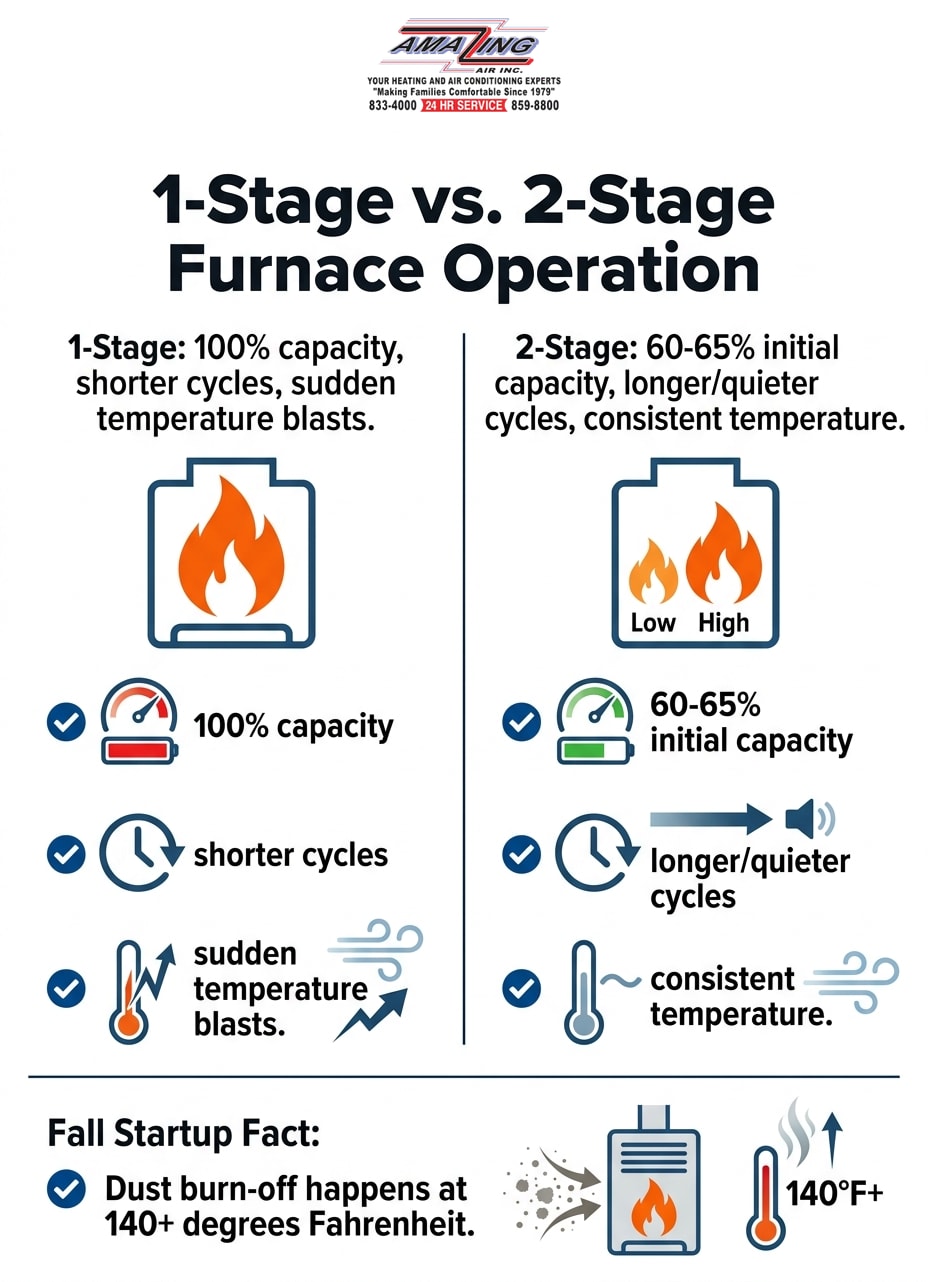
A 1-stage (or single-stage) furnace is the most basic design. It has only one setting: high. Whenever your thermostat calls for heat, the gas valve opens completely, and the blower motor runs at 100% capacity. It delivers a sudden, powerful blast of hot air until the thermostat reaches the target temperature, and then it shuts down completely. This constant on-and-off cycling can lead to noticeable temperature swings in the home.
A 2-stage furnace features a gas valve and blower motor that can operate at two different levels. The first stage acts as a "low gear," operating at roughly 60% to 65% capacity. The system will always try to use this low, quiet, energy-efficient stage first. If the outdoor temperature drops significantly and the first stage cannot keep up, the furnace shifts into its second stage, utilizing 100% capacity to conquer the extreme cold.
To make the differences clear, here is a breakdown of how these systems compare across key operational metrics:
• Heating Capacity — 1-Stage Furnace: Always 100% (Full blast) — 2-Stage Furnace: 60-65% (Stage 1) or 100% (Stage 2)
• Cycle Length — 1-Stage Furnace: Short, frequent cycles — 2-Stage Furnace: Longer, continuous cycles
• Noise Level — 1-Stage Furnace: Loud upon startup and operation — 2-Stage Furnace: Significantly quieter in Stage 1
• Temperature Swings — 1-Stage Furnace: Noticeable hot and cold spots — 2-Stage Furnace: Consistent, even temperatures
• Energy Efficiency — 1-Stage Furnace: Standard efficiency — 2-Stage Furnace: Higher overall efficiency
While 2-stage systems have different upfront costs compared to their 1-stage counterparts, the mechanical differences result in vastly improved acoustic profiles and long-term energy efficiency.
If you recently upgraded your home's heating equipment with our team, you might notice a distinct change in how the system behaves. One of the most frequent concerns our Amazing Air Inc installers hear from homeowners in North Aurora, IL (Chicagoland area) who just installed a modern unit is that the system seems to run constantly. They worry that a furnace running for 45 minutes straight must be broken or wasting energy.
In reality, longer, lower-capacity cycles are an intentional design feature of 2-stage furnaces, not a malfunction. When severe winter weather brings freezing temperatures to the region, the consistent, even heating capabilities of a 2-stage furnace prevent drastic temperature swings in the home. Instead of blasting the house with heat and then shutting off (which allows the rooms furthest from the thermostat to freeze), the system runs continuously at a lower speed. This gentle, constant circulation provides better temperature consistency and eliminates uncomfortable hot and cold spots.
Another massive, often overlooked benefit of longer run times is improved indoor air quality (IAQ). Your HVAC system is the lungs of your home. When the blower motor is running, air is constantly being pulled through your return vents and passed through your HVAC filtration system. Because a 2-stage system runs for longer durations at a lower speed, it filters your home's air much more frequently than a 1-stage system that only runs in short bursts.
It sounds counterintuitive, but running longer actually saves energy. Think of it like driving a car on the highway. Maintaining a steady speed of 55 MPH for a long stretch is far more fuel-efficient than constantly accelerating to 80 MPH, slamming on the brakes, and accelerating again. By avoiding the massive energy spikes required to constantly start and stop a blower motor at 100% capacity, 2-stage systems use less energy overall while keeping you more comfortable.
Observation is an important part of homeownership, but knowing when to call for backup is vital for your safety. A mid-fall heating startup in October is the perfect time to evaluate your system's health, but you must know where to draw the line between a minor quirk and a major hazard.
If you experience any of the following symptoms, it is time to transition from observing to scheduling an appointment with our team:
• Persistent odors: A burning smell that lasts longer than a few hours, or any smell resembling melting plastic, electrical ozone, or sulfur (rotten eggs, which indicates a gas leak).
• Ignition failure: The system clicks repeatedly but never actually produces warm air, or it turns on for two minutes and immediately shuts down (short cycling).
• Alarming noises: Loud booming upon startup, metal-on-metal scraping, or loud electrical humming without airflow.
• Carbon monoxide detector alerts: If your CO detectors sound an alarm, evacuate the home immediately and call emergency services.
At Amazing Air Inc, we believe in transparent expertise. When you book a professional diagnostic, you are investing in a transparent, high-value step to ensure your family's safety. A licensed technician does not just guess at the problem; they use specialized tools to measure exactly what is happening inside the cabinet.
During a pre-winter inspection, our professionals will test the static gas pressure to ensure the burners are firing correctly. We use a combustion analyzer to check for dangerous carbon monoxide leaks. We will measure the electrical amp draw on the blower motor and inducer motor to see if they are overworking and close to failure. Finally, our technicians perform a visual and camera inspection of the heat exchanger to look for microscopic cracks that could leak exhaust gases into your home's airstream.
This level of thoroughness is exactly why investing in a proper HVAC diagnostic visit is so crucial. An expert evaluation determines definitively if a simple repair is sufficient, or if the system has become unsafe to operate.
Sometimes, a diagnostic visit from our technicians confirms what you already suspected: your aging 1-stage furnace is failing, inefficient, or unsafe to operate for another North Aurora, IL (Chicagoland area) winter. While facing a replacement can feel daunting, making the switch to a modern system is an investment that pays dividends in comfort and peace of mind.
Replacing an aging, unsafe unit with a high-efficiency 2-stage system transforms how your home feels during the winter. While upfront costs exist, the long-term energy savings and improved comfort offer a strong return on investment. You eliminate the loud operational noises, banish the cold spots in your bedrooms, and significantly reduce the amount of energy required to maintain a comfortable indoor temperature.
To help offset the initial investment of a new installation, homeowners should always look into available incentives. General energy rebates or federal tax credits may apply to qualifying high-efficiency installations. Because these programs change frequently, we always advise checking with your local utility provider or a qualified tax professional to see what generic incentives you might qualify for this season.
Furthermore, upgrading your home's infrastructure does not have to drain your savings. We highlight the availability of flexible heating financing options to reassure homeowners that upgrading to a high-efficiency 2-stage system is a smart, accessible, and manageable investment for their family's future.
This is caused by dust and debris that settled on the heat exchangers during the summer months. When the furnace ignites and temperatures exceed 140 degrees Fahrenheit, this dust incinerates. It is a completely normal part of the first seasonal startup and is not a cause for panic.
A normal dust burn-off smell should dissipate within 30 to 60 minutes of continuous operation. You can open a few windows to help clear the air faster. If the smell persists for several hours or smells like melting plastic, shut the system down and call a professional.
Yes, longer run times are an intentional design feature of 2-stage systems. By running continuously at a lower capacity (around 60-65%), the system maintains consistent temperatures, improves air filtration, and uses less energy than stopping and starting constantly.
You can expect to hear a few rapid clicks as the ignitor fires, followed by a gentle whoosh of air as the blower motor engages. You may also hear popping or pinging sounds from your vents; this is simply the metal ductwork expanding as hot air hits the cold sheet metal.
You should contact a licensed technician immediately if you hear loud banging or booming (indicating delayed ignition), continuous electrical humming without any airflow, or harsh metallic scraping. These sounds point to mechanical failures that require expert diagnosis and repair.
No, a 1-stage furnace cannot be converted into a 2-stage system. The internal components, specifically the gas valve, the blower motor, and the computerized control board, are fundamentally different. To get 2-stage performance, you must install a system designed with 2-stage technology from the factory.
Navigating the transition into fall doesn't have to be stressful. By understanding the difference between normal seasonal burn-off and genuine safety hazards, you can confidently manage your home's heating needs. If your system is making strange noises, emitting persistent odors, or simply struggling to keep up, do not wait for a total breakdown in the middle of a blizzard. Proactive care is the best way to protect your investment and your family. Reach out to our team at Amazing Air Inc today to schedule an inspection or enroll in a comprehensive furnace maintenance plan, ensuring your equipment operates safely and efficiently all winter long.
Exceptional service and professionalism, exceeding expectations every time.