Your house is uncomfortably warm, but when you look at your mechanical room to plan an upgrade, you notice a glaring issue: the ductwork sits completely flush against the top of your heating unit. Successfully retrofitting AC to a poorly planned furnace: overcoming bad installations in North Aurora begins with diagnosing this exact "boxed-in" dilemma. At Amazing Air Inc, our team frequently encounters this scenario. A boxed-in furnace lacks the vertical or horizontal clearance required to house an evaporator coil, which is the critical component that actually cools the air inside your home.
Without adequate plenum space—the sheet metal box immediately above or beside the furnace where air is distributed—adding central air seems physically impossible. The existing ductwork physically blocks the integration of new cooling equipment. This leaves many homeowners facing a frustrating decision point: do you attempt extensive ductwork modifications, or are you forced into a total system replacement just to get some relief from the heat?
The good news is that poorly planned original installations do not automatically mandate starting from scratch. While a boxed-in setup is restrictive, we have found it is often a correctable structural issue rather than a death sentence for your current heating equipment. By evaluating the surrounding architecture in your North Aurora home, our professionals can often carve out the necessary space. If you are exploring air conditioning systems for a home that was never properly prepped for one, understanding the mechanics of your existing setup is the first step toward a comfortable living space.
The Mechanical Reality of Poorly Planned Heating Systems
To understand how to fix a boxed-in system, you have to look at why these spatial constraints occur in the first place. In our years of servicing local homes, we've seen that original installation oversights often stem from contractors prioritizing immediate, budget-friendly heating needs over future cooling integration. Decades ago, builders simply did not leave room for central air because it was viewed as a luxury rather than a standard necessity.
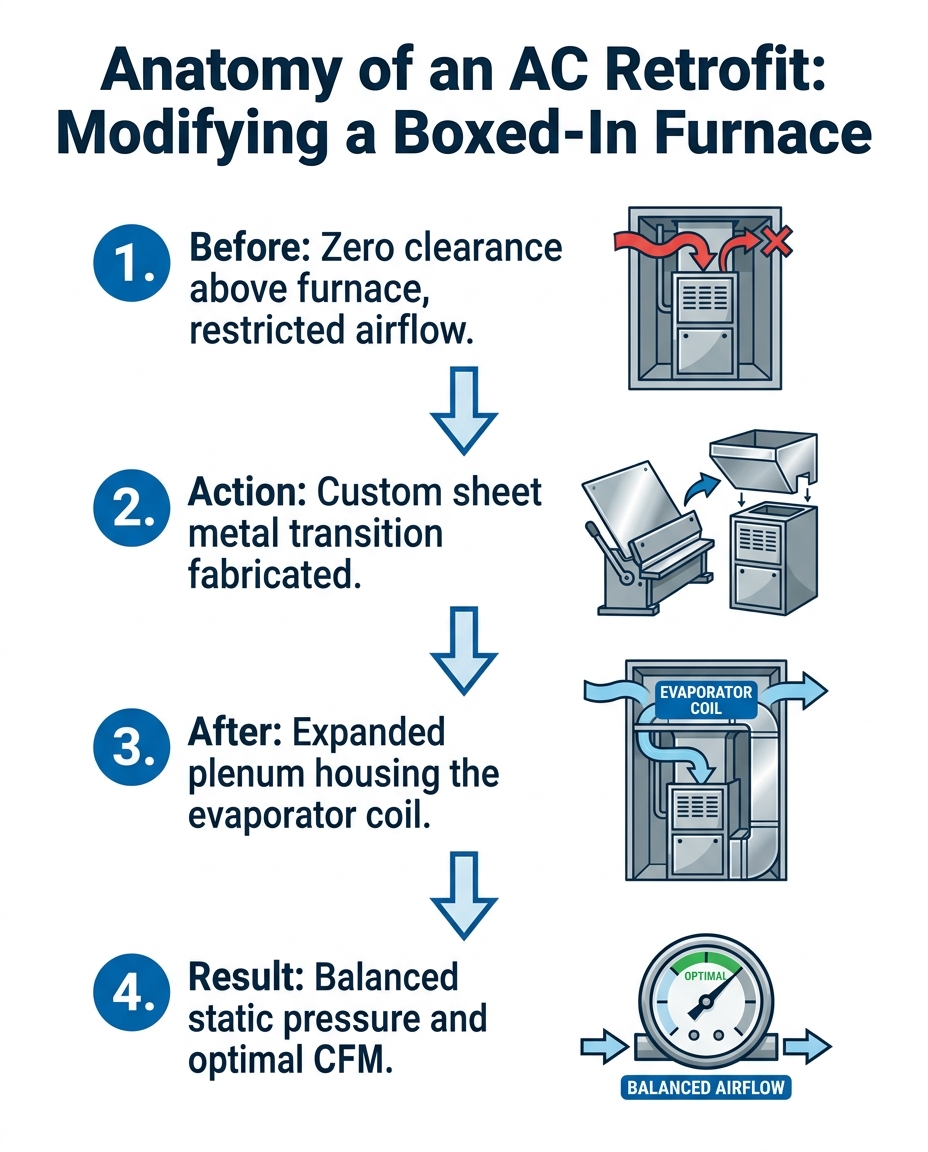
In older home designs, utility closets and basement mechanical corners were built as tightly as possible to maximize usable square footage elsewhere in the house. This historical building practice explains why some older buildings lack proper air conditioning infrastructure entirely. When the original furnace was installed, the sheet metal supply trunk was dropped directly onto the unit, leaving zero clearance for future upgrades.
These structural limitations are compounded when water heaters, structural support beams, or low basement ceilings crowd the immediate area around the furnace. The result is a mechanical reality where every inch of space is already spoken for, making any standard retrofit impossible without specialized professional intervention.
Identifying Spatial Constraints
Recognizing the severity of a boxed-in installation requires looking at a few specific mechanical indicators. If you are assessing your North Aurora property's mechanical room, here is what our technicians typically look for when diagnosing a restrictive setup:
• Zero vertical clearance: The main supply trunk connects directly to the top of the furnace without a transitional sheet metal box (the plenum) in between.
• Rigid return drops: The large duct pulling air back into the furnace is wedged tightly against the unit and a structural wall, preventing the furnace from being shifted horizontally.
• Obstructed access panels: Gas lines, PVC venting, or electrical conduits are routed directly across the space where an evaporator coil would normally sit.
• Low ceiling joists: The basement ceiling is simply too low to accommodate the extra 18 to 24 inches of height required by a modern cased coil.
Why Plenum Space Dictates Evaporator Coil Success
The supply plenum is arguably the most critical component of your ductwork when it comes to retrofitting central air. This is the central hub where conditioned air is pressurized before being pushed out to the individual vents in your home. When you add AC, the evaporator coil must sit precisely inside this plenum, directly in the path of the airflow.
General ASHRAE (American Society of Heating, Refrigerating and Air-Conditioning Engineers) residential airflow standards and Department of Energy (DOE) guidelines mandate specific minimum clearances for evaporator coils. If a coil is crammed into a space that is too small, the physics of heat transfer break down. The system relies on a massive volume of warm air passing over the freezing-cold refrigerant lines inside the coil. If the plenum is heavily restricted, airflow plummets, the condensation on the coil freezes solid, and the entire system shuts down.
This is especially critical in our specific region. In our experience, North Aurora experiences extreme temperature swings, from freezing, bone-chilling winters to hot, heavily humid summers. This volatile climate demands a perfectly balanced, dual-purpose HVAC system without compromised airflow. The plenum must be perfectly sized to handle both the heavy, restrictive heating demands of a powerful furnace and the rigorous, high-velocity cooling demands of a modern air conditioner. You cannot cheat the physics of airflow; the space must be mathematically correct to prevent premature compressor failure.
Professional Ductwork Modifications to Rescue Existing Systems
When a furnace lacks the required plenum space, the solution is never DIY experimentation—it requires highly technical sheet metal fabrication. Rescuing an existing heating system involves professional, invasive ductwork modifications to physically create the room the new evaporator coil needs. This is where our team's advanced mastery of custom ductwork and airflow dynamics shines, showcasing the technical capability to correct other contractors' botched jobs and save your functional equipment.
Because these modifications directly impact the safety and efficiency of your gas or electric furnace, they must be executed by licensed professionals. When our team performs a transition, we follow a strict protocol to ensure structural integrity and perfect airflow:
• System isolation and teardown: Our technicians carefully disconnect the existing supply trunk from the furnace and remove the restrictive original sheet metal.
• Evaluating the blower capacity: We measure the internal cavity to ensure the new dimensions will support the required Cubic Feet per Minute (CFM) of air.
• Custom transition fabrication: Our fabricators cut, bend, and form sheet metal on-site to route the air safely around tight architectural constraints, creating a flared or offset plenum.
• Coil integration: We securely mount the new cased evaporator coil above the furnace, perfectly leveled to ensure proper condensation drainage.
• Sealing and insulation: The entire new plenum assembly is sealed with mastic and insulated to prevent energy loss and condensation sweating.
If you are planning for a furnace installation and repair or an AC retrofit, scheduling this level of invasive sheet metal work during the September pre-heating season transition is ideal. It allows our technicians to completely rebuild the plenum while the weather is mild and ensures you are ready before the winter cold hits.
Custom Sheet Metal Fabrication
The secret to rescuing a boxed-in furnace lies in custom fabrication. Off-the-shelf duct components rarely fit into poorly planned, asymmetrical mechanical closets. Our professionals build custom transitions that expand the internal cavity just enough to house the coil while maintaining the structural integrity of the main trunk line. This bespoke approach ensures that the air is smoothly directed through the coil rather than slamming into flat metal walls, which would cause turbulence and noise.
Anatomy of an AC Retrofit: Modifying a Boxed-In Furnace
Balancing Airflow Dynamics and Blower Motor Requirements
Creating physical space for the evaporator coil is only half the battle; the secondary challenge of retrofitting AC is ensuring your existing furnace can actually push air through it. Adding a dense, tightly finned AC coil into the airstream inherently increases the static pressure of your ductwork. Static pressure is essentially the resistance to airflow within the system. When resistance goes up, the blower motor has to work significantly harder to deliver the same amount of air into your living spaces.
Cooling a home requires a different airflow dynamic than heating it. Cold air is dense and heavy, meaning it requires higher fan speeds—measured in Cubic Feet per Minute (CFM)—to reach the second-floor bedrooms or distant corners of the house. A furnace blower motor that was perfectly adequate for pushing warm air might struggle to push cold air through the newly added restriction of an evaporator coil.
During a retrofit, our technicians thoroughly evaluate the existing blower motor. If you have an older Permanent Split Capacitor (PSC) motor, it may lack the torque necessary to overcome the new static pressure. In some cases, we can manually adjust motor speeds to prioritize the higher cooling demands. In other setups, a motor upgrade to an Electronically Commutated Motor (ECM) might be necessary to provide variable-speed power that adapts to the resistance.
Balancing the system ensures that both the new AC and the existing heating components operate efficiently without burning out the blower. When assessing your heating solutions in North Aurora, this careful calibration by our team is what prevents your newly rescued furnace from failing mid-winter due to an overworked motor.
Avoiding Unnecessary Total System Replacements
When faced with a boxed-in furnace, we've seen some contractors immediately push for a total system replacement, claiming the ductwork is too far gone to save. While there are legitimate scenarios where starting fresh is the only safe option, many homeowners are forced into premature replacements simply because a technician lacks the sheet metal skills to modify the existing setup. Understanding the criteria for modification versus replacement can save your functional equipment from the landfill.
At Amazing Air Inc, we believe the value of an honest technical assessment cannot be overstated. A trusted advisor focuses on identifying your home's true needs and performing efficient, targeted modifications rather than defaulting to the most expensive overall replacement. For example, one North Aurora homeowner recently needed to replace home humidifiers connected to dual furnaces. Because they were new to the community, they were wary of being oversold. Our technician identified the exact needs, performed the replacements quickly, and ensured the existing equipment was optimized without pushing for an unnecessary dual-system overhaul. That same philosophy applies to our boxed-in AC retrofits.
To help you navigate this decision, here is a breakdown of when a modification makes sense versus when a full replacement is the smarter investment:
• Furnace Age — Candidate for Ductwork Modification: Under 10-12 years old with plenty of functional life remaining. — Candidate for Total System Replacement: Over 15 years old, nearing the end of its mechanical lifespan.
• Heat Exchanger Condition — Candidate for Ductwork Modification: Solid, rust-free, and passes a strict combustion analysis. — Candidate for Total System Replacement: Showing signs of rust, cracking, or combustion leakage.
• Blower Motor Capacity — Candidate for Ductwork Modification: Motor can be adjusted or easily upgraded to handle increased static pressure. — Candidate for Total System Replacement: Motor is undersized and the furnace cabinet cannot house a larger upgrade.
• Current Efficiency — Candidate for Ductwork Modification: High-efficiency model (90%+ AFUE) that keeps winter heating bills low. — Candidate for Total System Replacement: Low-efficiency model (80% AFUE or less) that wastes considerable energy.
By contrasting the scope of a custom plenum modification against a full HVAC overhaul, you can make a data-backed decision. If your furnace is relatively young and highly efficient, investing in custom sheet metal fabrication with our team is the logical path forward.
Frequently Asked Questions About Furnace and AC Retrofitting
Can you add an AC coil to an older furnace?
Yes, our team can add an AC coil to an older furnace, provided the furnace is in safe working condition and the blower motor can handle the increased airflow resistance. A professional must assess the heat exchanger for cracks and ensure the ductwork has enough physical space to house the new evaporator coil. If the furnace is severely aged or failing, replacing both units simultaneously is usually the safer route.
How much space is needed for an evaporator coil?
An evaporator coil typically requires between 18 to 24 inches of vertical clearance inside the supply plenum directly above or beside the furnace. This measurement varies depending on the tonnage of the AC unit and the specific manufacturer's design. If this space does not currently exist, a professional sheet metal fabricator will need to rebuild the ductwork transition to create the necessary room.
Do you have to replace the furnace when adding AC?
You do not have to replace the furnace when adding AC if your current heating unit is relatively young, highly efficient, and mechanically sound. As long as the blower motor can be adjusted to support the cooling system's airflow requirements, a standalone AC retrofit is entirely possible. However, if the furnace is over 15 years old, replacing both at the same time will save on overlapping labor costs.
Can you add AC to a furnace without a plenum?
You cannot add central AC to a furnace that lacks a supply plenum, because the evaporator coil must sit inside a properly sized sheet metal housing to function. If your ductwork connects directly to the furnace with zero clearance, the system is considered "boxed-in." To resolve this, a professional must fabricate a custom transition plenum to safely integrate the cooling equipment.
How do professionals modify ductwork for an evaporator coil?
Professionals modify ductwork by isolating the furnace, removing the restrictive original sheet metal, and custom-fabricating a new transition piece on-site. This new flanged or offset plenum is designed to expand the internal cavity, providing exact clearances for the new coil. The final assembly is then meticulously sealed with mastic and insulated to prevent air leaks and condensation.
What happens to static pressure when an evaporator coil is added?
When an evaporator coil is added to an existing furnace, the static pressure inside the ductwork inherently increases due to the dense fins of the coil restricting the airstream. This increased resistance means the blower motor must work harder to distribute air throughout the house. Technicians must measure this pressure and adjust the fan speeds to ensure both heating and cooling operate efficiently.
Finalizing Your Climate Control Strategy Before Winter
Poorly planned, boxed-in furnaces are a frustrating hurdle, but they can often be successfully modified for central air without the burden of a full system replacement. By understanding the critical role of the supply plenum and the necessity of custom sheet metal fabrication, you can rescue your existing equipment and finally achieve whole-home comfort. The key is relying on deep technical expertise to rebuild the airflow pathway correctly the first time.
Because these modifications involve invasive ductwork changes and system recalibrations, timing is everything. Completing this work during the September pre-heating season transition ensures that your furnace is fully operational, safely tested, and ready to perform long before North Aurora's freezing temperatures arrive. Federal tax credits or local utility incentive programs may also apply to qualifying high-efficiency AC or heat pump installations, so it's worth checking with your utility provider or tax professional to see what generic rebates are available this fall. If your mechanical room looks too tight for an upgrade, reach out to the Amazing Air Inc team to have an expert evaluate your existing furnace setup today.
Thank you! Your submission has been received!
Oops! Something went wrong while submitting the form.
A boxed-in furnace lacking plenum space makes adding central air feel impossible. We explore how targeted ductwork modifications can rescue your system without forcing a total replacement.
A technician fixes your late-summer AC rattle in five minutes, but you still pay a diagnostic fee. Discover why professional expertise and overhead justify the cost.
Choosing the right HVAC air filter can enhance your home's air quality. Learn about MERV ratings and find the best furnace filter for your needs today!