## Furnace Won’t Ignite? Local Troubleshooting, Safe DIY Checks, and Expert Help
When a furnace’s ignition system can’t create or sense a steady flame, the unit will lock out and your home loses heat. Prompt diagnosis matters — sometimes the fix is simple, like cleaning a flame sensor or changing a filter; other times it’s a serious safety issue, such as a faulty gas valve or electrical short that needs immediate professional attention. This guide walks you through the most common reasons a furnace won’t ignite, safe homeowner checks you can try, and clear signs it’s time to call a licensed technician. You’ll learn to spot symptoms like clicking, repeated lockouts, or a cold hot-surface ignitor and how those clues point to parts like the ignitor, flame sensor, pressure switch, and control board. After safe DIY checks, we outline what pro diagnostics typically include, share local cost ranges for ignition repairs in [North Aurora](/service-areas/north-aurora-il/) and Aurora, IL, and explain maintenance options that lower the chance of future failures. If any check raises safety concerns, we explain how local service pros and emergency response can get your heat back safely.
## Why isn’t my furnace igniting?
A furnace can fail to ignite for several reasons — mechanical, electrical, airflow-related, or safety-control issues — and sorting these categories quickly helps narrow the cause. Mechanical and electrical problems include worn ignitors, bad ignition modules, or tripped breakers that cut power to ignition components. Airflow and combustion problems such as clogged filters, blocked vents, or a weak inducer fan can cause unstable flame or shutdowns. Safety devices like flame sensors, pressure/draft switches, and high-limit switches will also stop ignition when they detect unsafe conditions. The short list below highlights the most common causes and points you toward logical next steps.
Knowing the main causes of ignition trouble makes troubleshooting faster and safer.
> **Furnace Troubleshooting: Causes & Solutions**
> Effective troubleshooting starts with knowing common problems, their causes, and practical fixes. Use inspection tools and your familiarity with the furnace to locate the root cause and apply the correct repair or preventive step.
- **Ignitor failure**: Hot-surface ignitor doesn’t glow or spark during attempts to light the burner.
- **Flame sensor fault**: Burner lights briefly but the sensor doesn’t detect flame, so the system shuts down.
- **Gas supply or gas valve issue**: No gas flow or valve won’t open when the system calls for heat.
- **Thermostat or power problem**: Thermostat set incorrectly, dead batteries, tripped breaker, or service switch off.
- **Airflow restriction**: Dirty filter or blocked vents limiting combustion air and causing shutdowns.
- **Safety interlocks**: Pressure/draft switch, condensate, or other safety devices preventing ignition.
These top causes point to simple first checks — power, filters, and [thermostat](/indoor-air-quality/smart-thermostats) — before moving on to component-level inspection. Understanding what each part does helps you decide which checks are safe and which require a pro.
### Ignition system failures: ignitor, pilot light, and ignition module
Ignition failures usually involve the parts that create the heat or spark to light the burner: hot-surface ignitors, pilot assemblies (if present), and ignition control modules. A failed ignitor typically shows no glow, repeated start attempts, or a clicking noise without flame. Pilot systems will show an out or constantly relighting pilot, and ignition modules can fail intermittently, causing random lockouts. Homeowners can watch for visible signs — no glow or persistent clicking — but should never touch hot parts and must stop immediately if they smell gas. If the ignitor stays cold or a pilot won’t light while you smell gas, leave the area and call a professional.
### Sensor and airflow impacts: flame sensor and dirty air filter
Sensors and airflow components keep ignition stable and safe by confirming a flame and providing combustion air. A dirty or corroded flame sensor can’t detect flame and will shut the burner off seconds after ignition. A blocked or dirty air filter reduces airflow, causing poor combustion and repeated ignition attempts or lockouts. Homeowners can safely replace disposable filters and, where manufacturer guidance allows, gently clean an accessible flame sensor — always with power off. Regular filter changes and scheduled maintenance reduce sensor fouling and airflow issues, cutting down emergency repairs and improving safety.
## Which ignition components should I inspect to diagnose problems?
When your furnace won’t ignite, concentrate on a short list of ignition-related parts and controls so you collect useful clues without doing invasive work. Key checks include the ignitor type and condition, flame sensor, gas valve and supply, thermostat and control signals, pressure/draft switch operation, circuit breakers/fuses, and the air filter and venting. Each part has typical symptoms that point to likely failures; matching what you see and hear to those symptoms speeds diagnosis and helps decide whether a homeowner fix is safe or a technician is needed. The quick reference below summarizes symptoms, likely causes, and homeowner-friendly next steps.
This table compares common ignition parts, typical symptoms, and practical next steps homeowners can take to identify the likely issue.
Component | Typical Symptom | Homeowner-Friendly Next Step
Ignitor (hot surface/spark) | No glow or no spark; repeated ignition attempts | Watch the sequence from a safe distance; don’t touch the ignitor. If there’s no glow, stop and call a pro.
Flame sensor | Burner lights then shuts off after a few seconds | Power off and, if accessible and allowed by the manufacturer, gently clean the sensor; replace if the problem returns.
Gas valve | No gas flow or valve clicks but no flame | Check other gas appliances to confirm supply; if you smell gas, evacuate and call emergency services.
Thermostat | No call for heat or wrong settings | Make sure thermostat is set to Heat and the setpoint is above room temp; replace batteries if needed.
Pressure/draft switch | Repeated lockouts or error codes | Inspect venting for obvious blockage; do not bypass safety devices — call a technician for proper testing.
Circuit breaker | No power to furnace controls | Check and safely reset the breaker. If it trips again, contact an electrician or HVAC technician.
Knowing how these parts fail and interact tells you which steps are safe and when professional tools are needed. If a component shows clear mechanical or electrical damage, a trained technician’s testing gear will be required to confirm and repair it safely.
## How can I troubleshoot furnace ignition issues myself?
You can perform a set of safe, non-invasive checks to gather information and sometimes fix simple issues. Start with basic items: confirm thermostat settings and batteries, make sure the furnace power switch is on, replace a dirty air filter, and verify the home’s gas supply is on. Then observe an ignition cycle — listen for clicks, look for ignitor glow, and note whether the burner lights and remains lit. If you smell gas, detect electrical burning smells, or see damaged wiring, stop immediately and call a professional. The checklist below is built for quick use and to help you capture useful details for a technician if needed.
- **Confirm thermostat and power**: Verify thermostat is on Heat and that the furnace service switch and circuit breaker are on.
- **Check the air filter**: Replace a dirty filter — restricted airflow often causes ignition trouble.
- **Observe the ignition sequence**: From a safe spot, watch for ignitor glow or clicking and whether the burner lights and stays lit.
- **Watch for safety triggers**: Note repeated lockouts, unusual odors, or visible wiring damage; these require a pro.
- **Document symptoms**: Record sounds, timing, and any error codes to share with a technician.
If the furnace still won’t ignite or you encounter any safety red flags, stop further DIY attempts and arrange for professional diagnosis. Clear, specific observations and any error codes you recorded will speed the technician’s work and often shorten on-site time.
### Step-by-step DIY checks for homeowners
Keep DIY checks non-invasive and include safety stops to avoid hazards or warranty issues. Turn off power at the service switch, check thermostat settings, and replace a visibly dirty [filter](/indoor-air-quality/whole-house-air-filtration). Restore power and observe the ignition sequence from a safe distance — note whether the inducer runs, the ignitor glows, and the gas valve opens, and record timings. Always follow these safety rules: if you smell gas, leave immediately and call emergency services; if breakers trip or you see frayed wiring, shut off power and call a technician. These cautious checks usually reveal whether a simple maintenance action or professional intervention is needed.
### Quick visual inspections: no flame or no click? what to look for
Short visual and audible checks give strong clues and help you decide next steps. No click or no ignitor glow usually points to an electrical or control issue like a failed ignitor or ignition module. Clicking without flame often signals a gas-valve or gas-supply problem. A brief flame that goes out suggests a fouled flame sensor, and the smell of gas with no ignition is an emergency — evacuate and call for help. If you see outside vent obstructions, remove them safely; otherwise, don’t open sealed components. These signs narrow likely faults and show when to call a trained technician.
## When should I call a pro for furnace ignition problems?
Call a professional whenever there are safety red flags, complex control faults, or diagnostics that require specialized tools. Quick professional help prevents unsafe operation and recurring failures. Immediate reasons to call include the smell of natural gas indoors, repeated ignition lockouts, electrical burning odors, visible wiring damage, and persistent breaker trips. Complex issues — pressure-switch faults, control-module error codes, or intermittent ignitor behavior — usually need meters, gas-pressure checks, and OEM parts knowledge. In North Aurora and Aurora, IL, local HVAC pros provide diagnostics, ignition repairs, emergency response, and maintenance plans to restore safe operation and reduce future problems.
- **Gas smell inside the home**: Evacuate, ventilate if safe, and call emergency responders or a qualified technician.
- **Repeated ignition lockouts**: Indicates a persistent component fault that needs professional testing.
- **Electrical burning odor or visible damage**: Stop using the unit and schedule immediate service.
- **Pressure/draft switch or venting faults**: Specialized testing is required to ensure safe combustion.
Amazing Air Inc. is a local North Aurora and Aurora, IL HVAC company offering furnace diagnostics, ignition repairs, and 24/7 emergency service. Our technicians can perform on-site testing, identify control-module or pressure-switch faults, and provide written repair or replacement estimates. To schedule service or request emergency help, please use the company’s [contact resources](/contact); sharing the observations you collected during DIY checks helps technicians prioritize diagnostics and speeds repairs.
### Safety red flags and complexity indicators
Put safety first by recognizing urgent signs that need professional attention instead of more DIY. A strong gas odor, repeated ignition cycles with lockout, visible electrical arcing or burning smells, and breakers that keep tripping are top red flags. High-efficiency systems can also show intermittent condensate or pressure-switch faults that need special tools to test venting and inducer performance. If any of these appear, clear the area, don’t operate the furnace, and arrange for a qualified technician to perform code-compliant diagnostics and repairs.
### What to expect from a pro visit: diagnostics, repairs, and costs
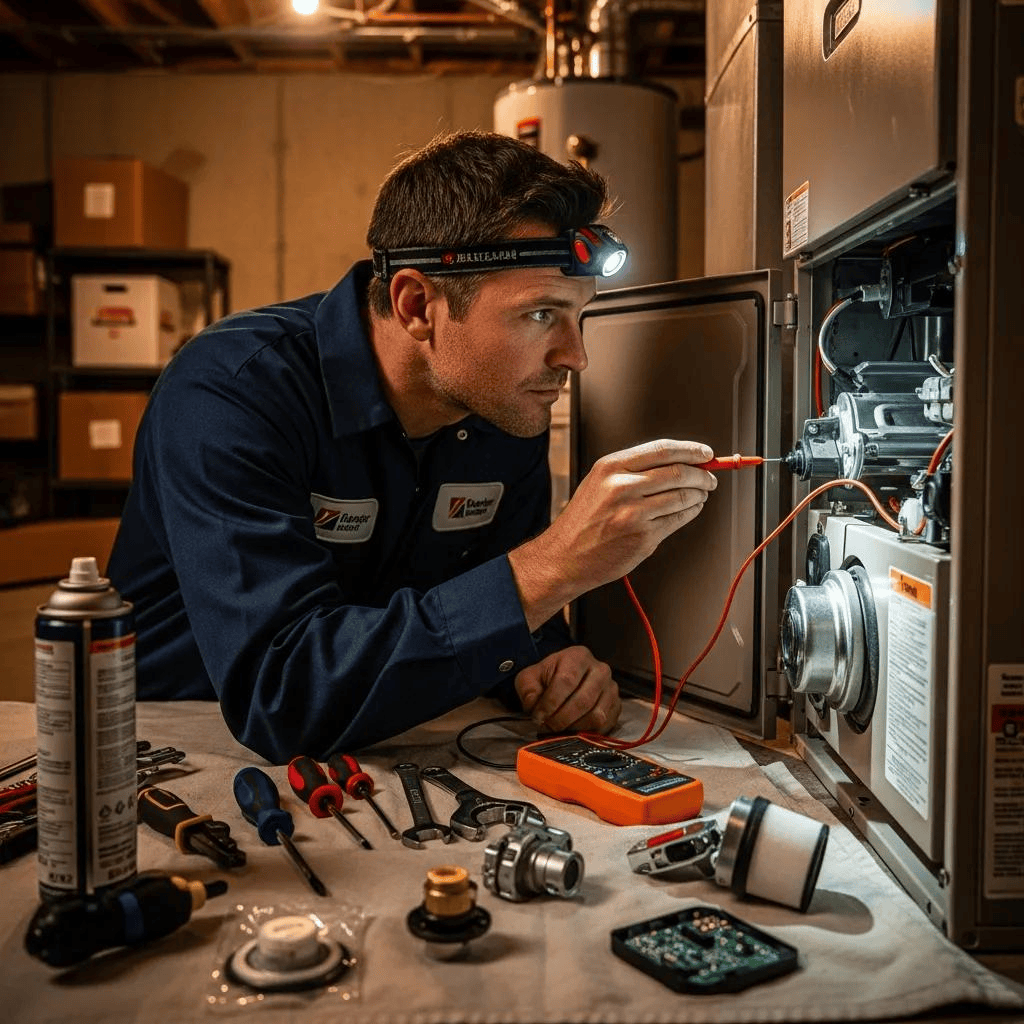
A technician’s visit usually begins with a visual inspection and a review of what you observed, followed by controlled ignition trials and component testing with meters and diagnostic tools. Common repairs include ignitor replacement, flame-sensor cleaning or replacement, gas-valve service, pressure-switch or inducer motor work, and control-module replacement; techs will also check venting and safety interlocks. Costs depend on parts, labor, whether it’s an emergency call, and furnace age; a written on-site estimate follows diagnosis. Having a list of symptoms, any error codes, and recent maintenance notes helps the tech diagnose faster and give a more accurate estimate.
## What are the costs and local service options for ignition repair in North Aurora and Aurora, IL?
Repair costs in North Aurora and [Aurora, IL](/service-areas/aurora-il/) vary with part complexity, labor, and whether service is after-hours. The table below shows typical local ranges and guidance on when replacement is recommended so you can set realistic expectations. Cost factors include furnace model, age, part accessibility, emergency dispatch, and whether a total system replacement is needed. Regular maintenance and seasonal tune-ups reduce ignition failures by allowing proactive cleaning and part checks, which lowers emergency repair frequency and lifetime cost. Maintenance plans typically include multi-point inspections and cleaning steps that address common ignition issues like flame-sensor fouling and airflow restrictions.
Repair Item | Typical Local Repair Range | When Replacement Is Recommended
Ignitor replacement | Moderate range (parts + labor), typically $150–$350 | When the ignitor is cracked, non-responsive, or fails repeatedly
Flame sensor cleaning/replacement | Lower to moderate range, typically $80–$200 | Replace if cleaning doesn’t fix the issue or the sensor is corroded
Control module / ignition module | Moderate to higher range, typically $300–$600 | Replace when the module shows diagnostic failure codes or intermittent faults
Pressure/draft switch or inducer motor | Moderate range, typically $150–$400 | Replace when the switch or inducer fails testing or venting is compromised
Emergency service call | Higher due to after-hours rates, often $100–$200 extra | When immediate heat restoration or a gas-safety risk exists
The table gives ranges rather than fixed prices and we recommend getting an on-site estimate for exact pricing. For North Aurora and Aurora, IL homeowners who prefer predictable upkeep, enrolling in a Gold Plan or similar maintenance plan provides scheduled tune-ups and priority service.
### Frequently Asked Questions
#### What are the signs that my furnace ignition system is failing?
Look for no glow from the ignitor, repeated clicking without ignition, or the burner lighting briefly and then shutting off. These signs often point to the ignitor, flame sensor, or gas supply. If you smell gas or hear unusual noises, stop using the furnace and call a professional right away.
#### How often should I perform maintenance on my furnace?
We recommend at least one annual maintenance visit, ideally before the heating season. That visit should include filter checks, flame-sensor cleaning, and an inspection of ignition components. Annual maintenance helps efficiency, reduces ignition problems, and extends furnace life. A maintenance plan adds priority service and repair discounts.
#### Can I troubleshoot ignition issues without professional help?
Yes — basic checks such as confirming thermostat settings, ensuring power is on, and replacing a dirty filter are safe and helpful. Observing the ignition sequence can reveal useful clues. But if you encounter safety red flags like a gas smell or electrical burning odor, stop and call a pro.
## Conclusion
Addressing ignition problems quickly keeps your home safe and comfortable. With basic checks you can rule out simple issues and gather the right information for a technician. Regular maintenance reduces the chance of emergency repairs and extends furnace life. For professional help, maintenance plans, or emergency service in North Aurora and Aurora, IL, [contact](/contact) local HVAC experts to get your system inspected and restored safely.